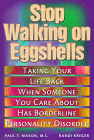
| Stop Walking on Eggshells | Taking Your Life Back When Someone You Care About has Borderline Personality Disorder |
| by Paul T. Mason & Randi Kreger |
 |
| Edition: | Paperback; 258 Pages | |
| Price: | $16.00 Deliver for as little as $3 | |
| Availability | Usually ships next US Mail day | |
| Publisher: | New Harbinger | |
| ISBN: | 1-57224-108-X |
When someone struggling in a relationship with a disordered partner or family
member first asks for help, I recommend two things. The second is to reflect and
come to know themselves and what is really important to them. This is where Tears
and Healing comes in. The first part is to learn as much as possible
about personality disorders, the behaviors they cause, and the prospects for
change in their partner. For this part, I recommend Stop Walking on Eggshells,
written by my friend and mentor Randi Kreger with Paul Mason.
While this book was written with borderline personality disorder in mind,
most of the book applies equally well to borderline, narcissistic, and
sociopathic disorders. In fact, as I’ve learned more and more about the
experiences of many people living with partners and family members who have
these disorders, it becomes clearer that a “pure” disorder is rare. In
reality, disordered behaviors seem mostly to fall in a region overlapping all
three disorders. So Stop Walking on Eggshells’ comprehensive explanation
of behaviors and defense mechanisms isn’t limited to just borderline disorder.
Among the book’s strengths:
- Chapter 2 gives an in depth look at the BPD diagnostic criteria. If you’re look at the criteria for any of these three disorders, you’ll find this helps you to understand what the criteria definitions mean. Chapter 2 also looks at behaviors, patterns of thought, and myths.
- Chapter 3 offers a valuable explanation of defense mechanisms, like projection and dissociation, that can help you understand the dynamics underlying disordered behavior. It also explains living with abuse becomes brainwashing and how disordered people can cycle between extremes of feeling and valuation of you.
- Chapters 4 and 5 talk about how abusive behavior can affect you, and offers some ways that you adjust your attitude to make yourself healthier.
- Chapters 6 and 7 offer approaches to cope with abusive behavior, and explain personal boundaries and how you can use them to make your situation more livable.
- Chapters 7 and 8 offer plans for making yourself and your children safer in an abusive situation.
If there are only two books in your hands as you wrestle with a personality
disorder in a partner or family member, those books should be Tears and
Healing, and Stop Walking on Eggshells.